How to avoid plagiarism, and how to fix it before you submit
Key takeaways
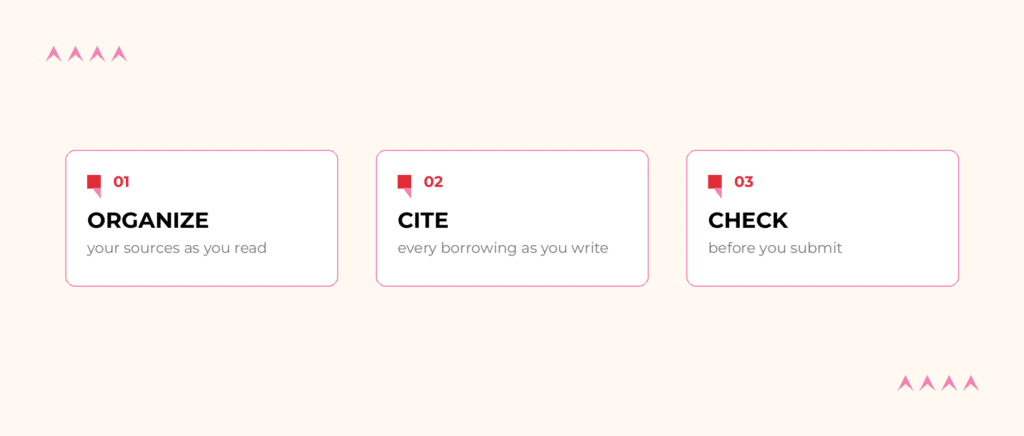
Avoiding plagiarism comes down to three habits: keep track of your sources as you read, flag every borrowing as you write it, and check your document before you hand it in. Everything else is method. Here is yours.
Let’s start with the good news: plagiarism is almost never a matter of dishonesty. It is a matter of organization. A reference noted in a hurry, a rewrite that stays a little too close to the original, a chart lifted without its author, and a serious piece of work loses marks for nothing.
If you first want to know what the term actually covers, its different forms and what it means for your academic record, start with our general article on plagiarism.
Here, we are talking method.
Before you write: organize your sources
Plagiarism rarely happens at the writing stage. It happens two months earlier, in a folder of notes where nobody can tell any more what came from where.
Record the full reference the moment you read it, not later. Author, title, publisher or website, year, a link to the exact page, and for anything online, the date you accessed it. Tracking down a reference two months later takes ten times longer than copying it on the spot. This is the one piece of advice in this article that will save you actual hours.
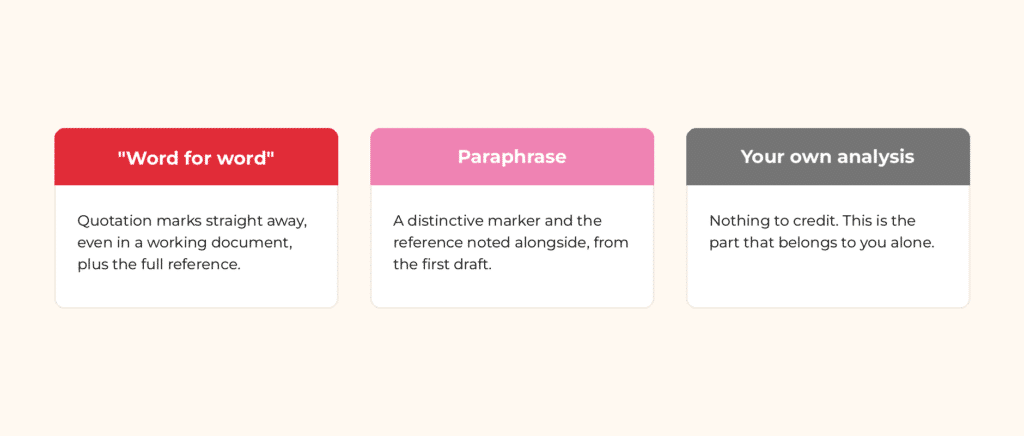
Separate three statuses in your notes, right from the note-taking stage:
- word-for-word passages, which you put in quotation marks immediately, even in a working document;
- rewritten passages, which you mark with a distinctive sign and the reference alongside;
- your own analysis, the part that belongs to you alone.
A simple color code will do. Without that sorting, the line blurs, and it is precisely in that blur that unattributed borrowings appear.
Finally, build your bibliography as you go rather than the night before the deadline. Our article on how to write an effective bibliography sets out what to include for each type of source.
While you write: three reflexes
You are using the exact words
Quotation marks, every time. They mark out what is not yours and make the borrowing entirely legitimate. Add the reference in the text, in a footnote, or both, depending on the style you have chosen.
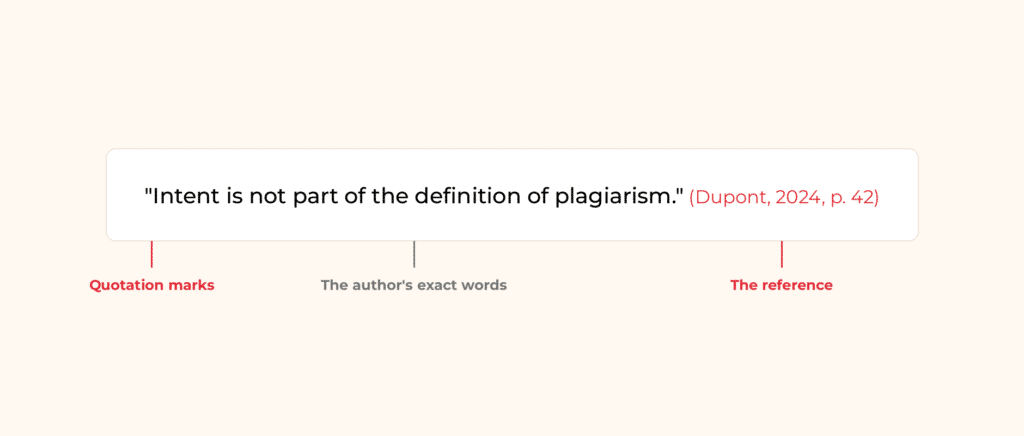
Watch the typographic detail, since conventions differ between British and American usage, and nested quotations follow their own rules. Our article on how to use quotation marks covers the whole question, including dialogue and titles of works. For placement in a footnote, see how to use footnotes.
You are putting it in your own words
Changing the words does not change who owns the idea. A rewritten passage is still a borrowing, and it is cited exactly like a direct quotation. This is the most common confusion by far, and the leading cause of flagged similarities in dissertations and theses.
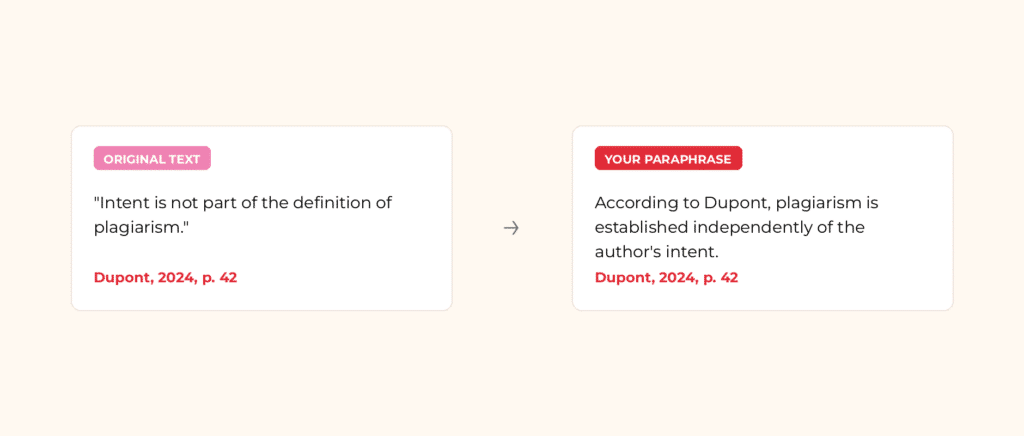
That said, do not give up on rewriting: it is an expected skill, and a valued one. It shows you have understood what you read instead of copying it. Simply attach the reference to every rewritten passage. For where the line falls, see when paraphrasing becomes plagiarism and the power of paraphrasing.
You are borrowing an idea, a figure, an image
A table, a photograph, an infographic, a dataset, a translation: these are works, and they are credited exactly like a paragraph. A chart you have redrawn yourself is still the work of whoever produced the numbers.
Four situations come up constantly and each has its own method:
- You are citing an author you have not read, found in someone else’s work. Name both, the original source and the one you actually read. See primary and secondary sources.
- Your source has no named author. The absence of a name does not remove the need to cite. See how to cite an anonymous source.
- You are reusing work you have already submitted. The same assignment cannot be credited twice, but nothing stops you reusing your own ideas as long as you cite yourself. See self-plagiarism.
- You are not sure whether something counts as common knowledge. See when common knowledge needs a citation. And if you are building a presentation, the rules do not relax: see citing sources in a slideshow.
One referencing style, from start to finish
APA, MLA, Harvard, Chicago, ABNT: each style defines what to include and in what order. None is better than the others. The only rule that matters is to use one, and to stick to it across the entire document.
Find out before you start writing. Most institutions specify their own, and Harvard is standard across much of the UK while APA and MLA dominate in the United States. Discovering the requirement three days before the deadline turns a formality into a very long night.
For the practical detail, in-text references, footnotes and bibliography entries, see our guides to APA style and MLA format.
Before you submit: your source check
Set aside a dedicated pass on your sources, separate from your content review and your spelling check. Twenty minutes is enough, and it pays for itself immediately.
Go through four points:
- Every passage in quotation marks carries its reference.
- Every reference cited in the text appears in the bibliography, and the other way round.
- One style is applied from start to finish.
- Images, tables and charts are credited, captions included.
That leaves the blind spot: the borrowings you forgot because you never noticed them. That is exactly what a plagiarism checker is for.
Check that everything is properly cited
Compilatio Studium compares your document against billions of sources, flags passages that resemble existing content and shows you their likely origin.
You stay in control of the corrections. The analysis tells you where to look. You decide what to do about it.
How to reduce your similarity score on a finished document
Your assignment is written, the report shows a percentage that worries you, and you do not know where to start.
First, a word about what not to do. A whole category of tools promises to bring your score down by swapping words for synonyms. Swapping words does not lower your score in any way that survives scrutiny. Citing does. A rewrite built out of a thesaurus reads badly, tells your marker nothing about your understanding, and leaves the underlying borrowing exactly as unattributed as it was. Here is the method that actually works.
1. Read the report before you change anything
A flagged passage is not a problem by default. A similarity score, sometimes called a similarity index, measures how much of your text resembles other content. It says nothing about attribution. A perfectly referenced quotation appears in the report exactly like a forgotten one.
So start by opening each flagged passage and looking at the source attached to it. Several categories will emerge straight away.
2. Sort the flagged passages into three piles
- Already cited correctly. Quotation marks, reference, bibliography entry. Leave them alone. This covers most flagged passages in serious work, particularly in law, medicine and any field where set phrases and official texts are unavoidable.
- A genuine borrowing, unattributed. This is where the work is.
- A false positive. A common phrase, a degree title, your bibliography matching someone else’s. Check it, then move on.
3. Decide: quote or rewrite
For each unattributed borrowing there are two outcomes, and one question to ask yourself: do the author’s exact words add something?
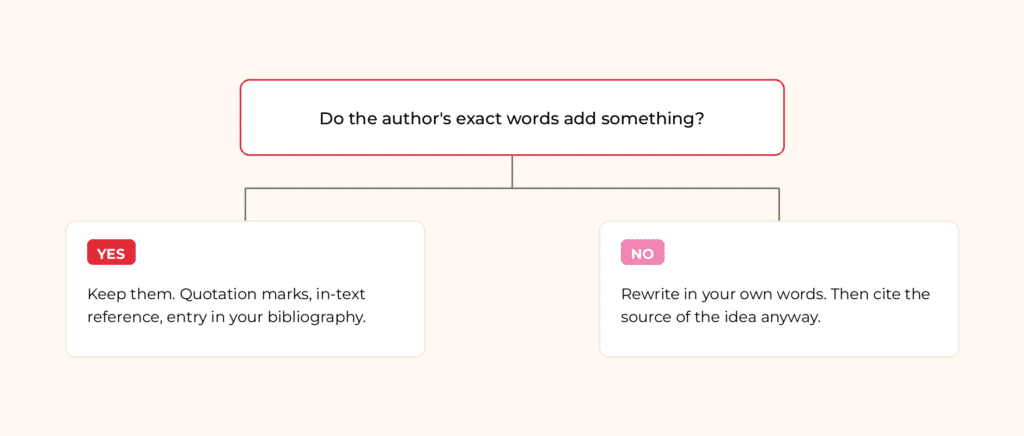
If they do, keep them and frame them properly: quotation marks, reference, bibliography. If they do not, rewrite the passage in your own words, then cite the source of the idea anyway. Rewriting is not a way of making a passage disappear from the report. It is a way of making an idea your own while staying transparent about where it came from.
A simple test: if you cannot explain the passage to someone without looking at the original text, you are not ready to rewrite it. Quote it.
4. Run a second check
Once you have made your corrections, run another analysis to confirm that the passages you treated have been taken into account and that none slipped through. Correctly referenced quotations will keep appearing, which is normal and frankly a good sign: it means your work rests on sources and shows it.
What about generative AI?
A conversational assistant can help you get a feel for a subject, tighten an awkward sentence or sketch out a structure. It becomes a problem the moment its output replaces your thinking without anyone being told.
Is using AI plagiarism? Not automatically, and this is where the confusion sits. Plagiarism is presenting someone else’s work as your own without attribution. Submitting AI-generated text as your own is a separate issue, usually covered by your institution’s academic integrity policy rather than by the definition of plagiarism itself. The consequences, however, are often the same.
Is using ChatGPT to rewrite a passage plagiarism? If the underlying idea comes from a source you have not cited, then yes, and the rewrite changes nothing. See does ChatGPT plagiarize for the full picture.
Three markers to stay on safe ground:
- Check your institution’s policy. They vary enormously, from an outright ban to declared and supervised use.
- Check every source the tool produces. Generative models invent references that look entirely credible. Always trace a reference back to the original publication before citing it. If you do need to reference the tool itself, see how to cite ChatGPT.
- Declare your use where it is permitted, specifying what you handed over to the tool.
Our AI detector identifies content that may have been generated by AI, which lets you measure how much of your submission is genuinely yours before your marker does.
Teachers: supporting rather than reacting
On the teaching side, prevention remains the most effective lever. Compilatio Magister analyzes submitted work, displays each source next to the passage concerned and leaves the interpretation to you, with teaching resources to raise awareness among your students in advance.
Compilatio Magister, alongside teachers
Every source appears next to the passage concerned, with teaching resources to prepare your students in advance. The analysis shows. You decide.
FAQ
How can you avoid plagiarism?
Three habits are enough: keep track of your sources as you read (full reference, and whether each note is a quote, a paraphrase or your own analysis), flag every borrowed idea as you write (quotation marks for exact wording, a reference for paraphrased content), then proofread the document before submitting it. That is the method detailed earlier in this article.
What are some tips to avoid plagiarism when paraphrasing?
Changing the words does not change who owns the idea: a paraphrase is still a borrowed idea and needs the same reference as a direct quote. Paraphrasing remains a valuable skill in itself, as long as each passage is credited to its source.
How can you avoid plagiarism with generative AI like ChatGPT?
Three checkpoints matter: check your institution’s policy on AI use, always trace the sources an AI tool produces back to the original publication (generative models sometimes invent references that look entirely credible), and disclose your use of AI when it is allowed. Our AI detector flags content that may have been AI-generated, so you can gauge how much of a submission is genuinely your own work before your instructor does.
How can you avoid plagiarism when writing a scientific paper or thesis?
Three checkpoints matter: check your institution’s policy on AI use, always trace the sources an AI tool produces back to the original publication (generative models sometimes invent references that look entirely credible), and disclose your use of AI when it is allowed. Our AI detector flags content that may have been AI-generated, so you can gauge how much of a submission is genuinely your own work before your instructor does.
Is there an app to help avoid plagiarism?
Compilatio Studium compares your document against billions of sources, flags passages that resemble existing content and points to their likely origin. The analysis does the detecting, you stay in control of what to correct.
Was this article helpful?

Jérémy STERN
As a recent graduate, I am convinced that a degree is only as valuable as what you have actually learned. I work every day to uphold this belief.