Plagiarism detector
Check the originality of an academic paper in just a few clicks.
Compilatio is a plagiarism checker that analyses your document, detects passages that are similar to existing sources, and provides a detailed similarity rate for each source identified. A solution accessible to both educational institutions and students.
2 million
users
+60
countries
+2000
institutions
+60
countries
2M
users
+40
available languages
95%
of institutions resubscribe
Teachers, students: to each their own tool
Plagiarism and AI detection (and much more) for teachers
Analyze your students' work in just a few clicks.
Compilatio Magister detects several types of similarities across billions of sources and identifies content potentially generated by AI.
Similarities and plagiarism: what’s the difference?
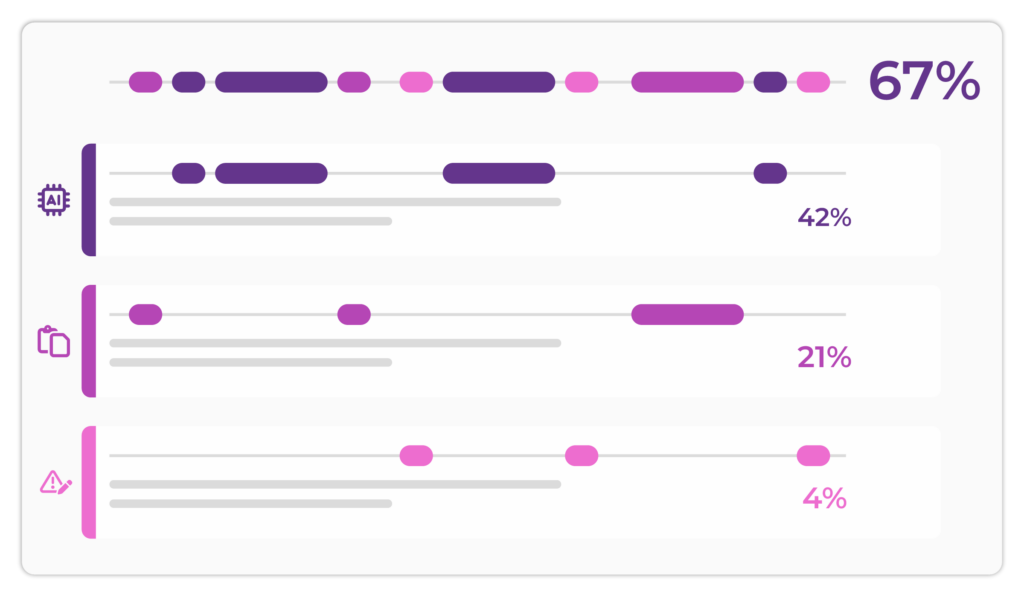
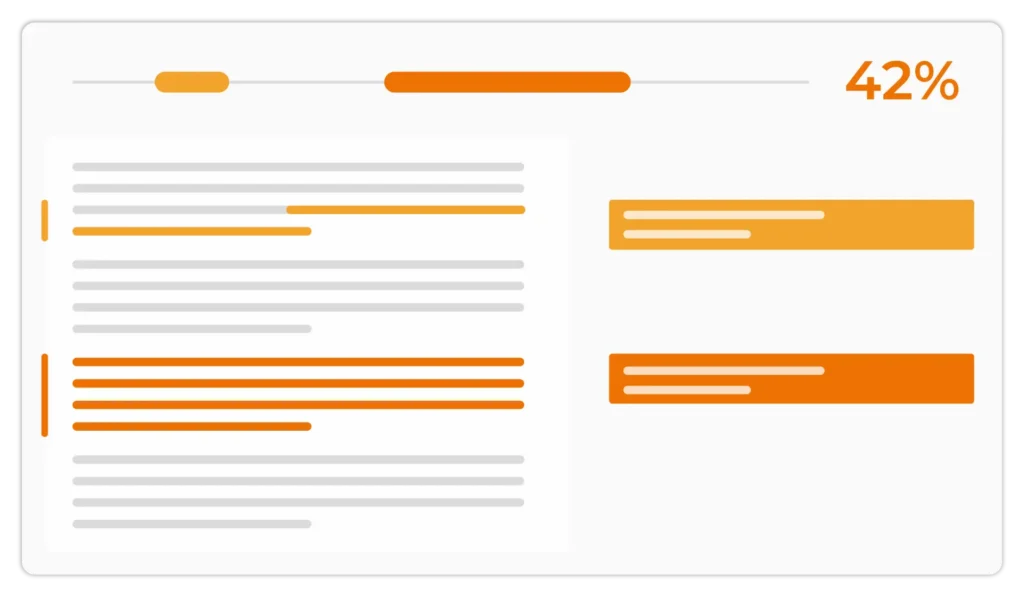
When Compilatio analyses a document, it detects similarities: passages in your text that match existing sources, whether these are web pages, academic publications or student work. This result is expressed as a percentage, the similarity rate: a starting point you interpret passage by passage.
For a full breakdown of what counts as plagiarism, see our what is plagiarism page.
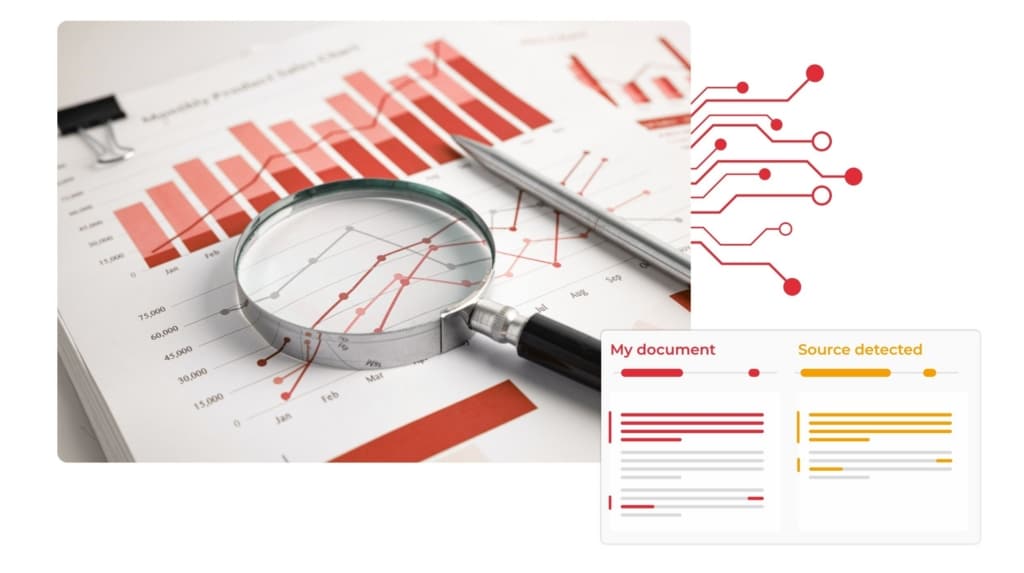
Compilatio locates similar passages, identifies the corresponding sources and allows you to compare them. It’s up to you to draw your own conclusions.
How does Compilatio analyze your documents?
Understanding how the analysis works also helps you understand why the results are reliable. Here’s how a document analysis is conducted.
Text extraction
Compilatio extracts the raw text content from your document, regardless of its format (PDF, Word, plain text, etc.). Metadata, images and formatting elements are removed so that only the text to be analysed remains.
Search for sources
The tool identifies information-rich data within the text and carries out a comparison against all available databases: the web, scientific publications and student work.
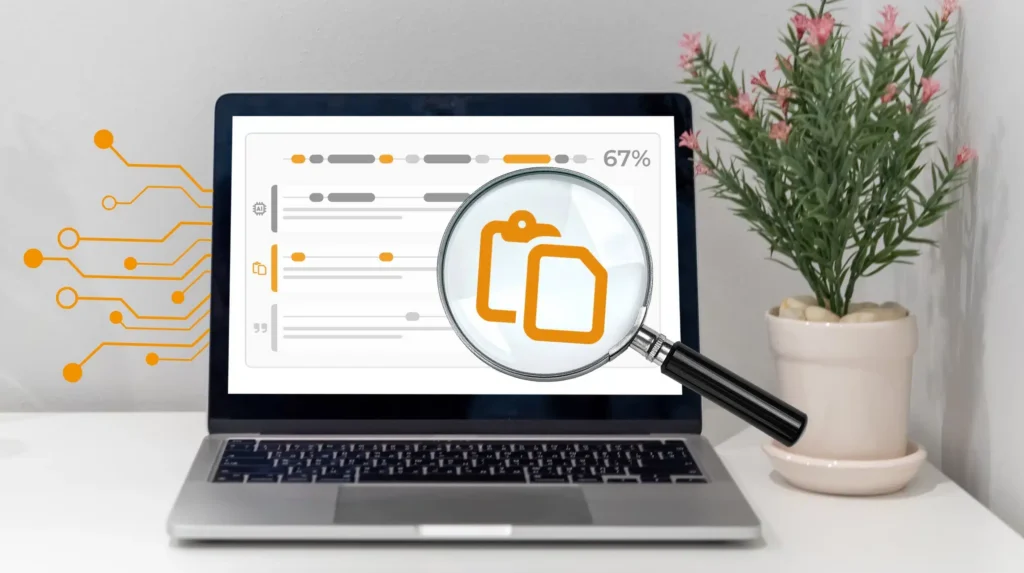
Identifying similarities
Compilatio compares the extracted text with all content sourced from the web, academic databases and student work submitted by client institutions. The tool identifies every similar passage, whether it has been copied verbatim, translated into another language, or reworded syntactically or semantically.
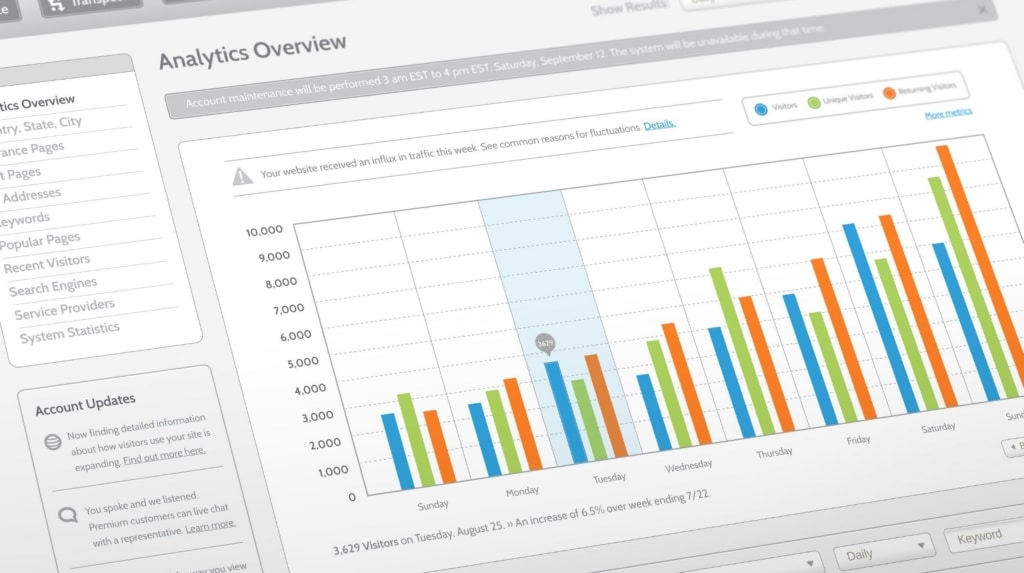
Cleaning up the results
Insignificant matches are filtered out: set phrases, standard legal terms, and quotations that are too short to be relevant. Only similarities that are genuinely useful appear in the final report.

The similarities that Compilatio can detect
The availability of these features depends on the solution you choose.
Monolingual similarity detection
Compilatio compares your document with millions of sources written in the same language and highlights any passages that match an existing source, whether they have been copied verbatim or slightly modified.
Detection of cross-linguistic similarities
Text translated from another language can still be detected. Compilatio identifies similarities between documents written in different languages and displays the source passage in its original language for direct comparison.
Detection of syntactic reformulations
Compilatio identifies passages that have been superficially rewritten: words replaced by synonyms, the order of sentences altered, or the structure slightly rearranged. The original meaning is retained, but the form has been changed to mislead a basic analysis. Compilatio detects these rewordings.
Detection of semantic reformulations
This is the most technically advanced level of detection. Compilatio detects passages where the meaning has been fully preserved despite extensive rewriting, even when no words or structural elements from the original source have been retained.
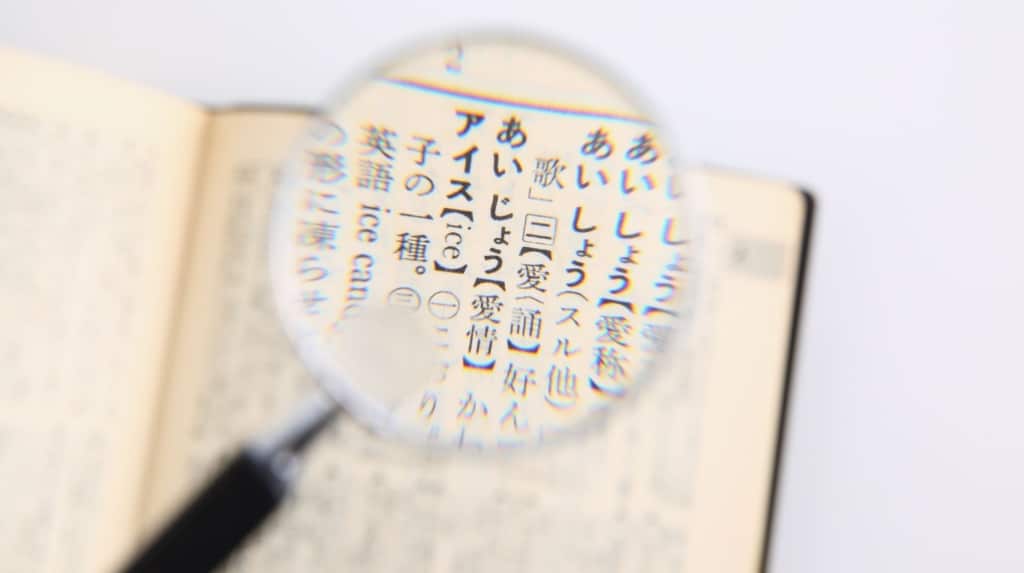
Detection available in over 40 languages
Compilatio is used in over 60 countries. Its ability to detect similarities, cross-language similarities and paraphrasing works in all languages in which academic work is produced within higher education.
Compilatio supports the world’s major languages.
In practical terms: A student who translates a passage from Mandarin into French, or who rephrases a Spanish text into English, does not slip through the net.
Languages covered: French, English, German, Spanish, Italian, Portuguese, Dutch, Polish, Arabic, Chinese, Russian, Turkish…
What sources does Compilatio use for its analysis?



The Web
Compilatio scans hundreds of billions of web pages available online, including archives of sites that are no longer active. If a passage has been published anywhere on the web, there’s a good chance it will be detected.
Scientific Publications
Over one billion academic documents are included in the comparison database: open-access publications, repositories from universities and research centers, and works from the world’s most influential institutions.
Student Papers (Compilatio Magister)
With Compilatio Magister, your institution can compare its students’ papers with those from other institutions in the network, in complete confidentiality. Good to know: this applies only to documents submitted via Magister, never to those analyzed with Compilatio Studium.
Our LMS Integrations
Compilatio Magister integrates with the most widely used LMS platforms in higher education and secondary education.







They use Compilatio on a daily basis










Want to detect plagiarism in your documents?
Whether you’re a teacher or a head of studies, Compilatio has a solution tailored to your school.
Are you a student? Discover Compilatio Studium.
Request a demo for my school
Your frequently asked questions, our clear answers
Does plagiarism-detection software detect translations?
Yes. Compilatio’s detection system is cross-language; it identifies rephrasings of text translated from one language to another. A student who translates a passage from Mandarin into French, or who rephrases a Spanish text into English, will have that passage flagged in the same way as a direct copy.
Does a plagiarism detector also identify content generated by AI, such as ChatGPT?
Yes, and that’s exactly what Compilatio does: plagiarism and AI are analyzed in a single report, for students using Compilatio Studium, and for teachers using Compilatio Magister. Since no AI detector can guarantee 100% reliability in this regard, we refer to text that may have been generated by AI: a result to be interpreted rather than absolute proof.
How does plagiarism-detection software work?
The document’s content is extracted before being compared to a very large number of sources (the web, academic databases, and previously submitted work). The tool identifies similar passages and calculates a similarity score, along with details of the relevant sources. This score is a starting point for interpretation, not an automatic verdict: it is up to the person reading the report to distinguish between legitimate citations and uncredited borrowing.
Is there any free plagiarism-detection software?
Some tools offer free access, which is often limited to a partial analysis or funded by reselling the analyzed documents to third-party databases. Before choosing a tool, it’s best to check what happens to your documents.
What are the different types of plagiarism?
Copying and pasting without citing the source is the most obvious form, but there are others: unattributed paraphrasing (rewording an idea without citing its source), translation plagiarism, self-plagiarism (reusing one’s own work without acknowledging it), or simply failing to cite a source, often unintentionally. Identifying these issues helps you avoid them next time.
What is plagiarism?
Plagiarism involves using another author’s words, ideas, or work without attributing them, thereby passing them off as one’s own. This ranges from verbatim copy-and-paste to uncited paraphrasing, as well as the translation of a foreign-language text presented as original work. In an academic setting, it stands in contrast to rigorous citation practices, which remain the best safeguard.
I’m a student. How can I check my paper before turning it in?
Compilatio Studium lets you analyze your own work before turning it in, with complete confidentiality: similarity scores, text potentially generated by AI, and a list of detected sources. It’s a way to turn in your work with confidence, having already identified what needs to be adjusted.
What percentage of plagiarism is considered acceptable in a master’s thesis or dissertation?
There is no universal threshold: each institution sets its own standards. As a general guideline, a similarity rate below 10% is generally considered normal (including citations and the bibliography); a rate between 10% and 25% warrants verification depending on the type of assignment; and a rate above 25% requires a careful review. The number alone never tells the whole story: what matters is the nature of the flagged passages.
For more details, see our article on the subject: “What level of plagiarism is acceptable?”