Plagiarism and AI detection API for your platform
Connect your platform to Compilatio via API and offer your users comprehensive detection of plagiarism, AI-generated content, and altered text, all hosted in France and compliant with the GDPR.
+30%
in usage
Contact us

They use Compilatio on a daily basis














What is the Compilatio API?
An API (application programming interface) allows two systems to communicate with each other. Compilatio’s API gives you access, from your own platform, to the full analytical power of Compilatio Magister: plagiarism detection, identification of AI-generated content, detection of altered text, and more…
You keep your interface. You add our analysis engine.
What the Compilatio plagiarism and AI detection API detects

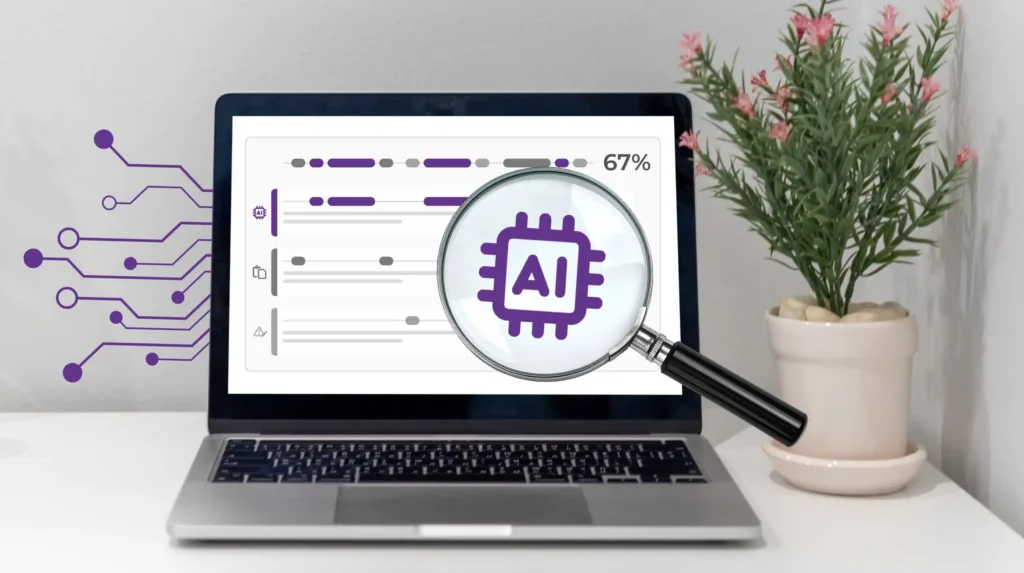

Similarities and Plagiarism
The API compares each submitted document against billions of web sources, academic databases, and previously analyzed documents, and returns an accurate similarity score, passage by passage, regardless of the original language.
Potentially AI-Generated Content
The API analyzes the structure and stylistic patterns of each text to identify passages that may have been written or reworded by a generative AI tool, and returns a probability score that can be used directly in your interface.
Altered Texts
The API detects even the most sophisticated attempts to circumvent detection, whether they involve character substitutions, invisible insertions, or automated rephrasing that traditional detectors miss.
Ready to integrate Compilatio into your platform?
Our technical team is available to discuss your project, assess your use case, and support you from documentation through to production deployment.
Contact us
Form
Proven technology since 2004
Compilatio has been analyzing academic documents for more than 20 years and now makes this expertise available to your technical teams through a stable, well-documented REST API, complete with practical examples, for seamless integration into your existing environment.
Data hosted in France
Every document submitted via the API is processed and stored exclusively on servers located in France, ensuring native GDPR compliance and avoiding any legal risks associated with transferring data outside the European Union.
Responsive technical support
Behind the API is a support team available to assist your developers at every stage of integration, answer technical questions, and ensure long-term service continuity.
Getting Started with the Compilatio API

Check the available integrations
First and foremost, check out our integrations catalog: if your platform is already compatible with Compilatio via an LMS connector or an existing plugin, you don’t need to use the API.

Talk to our team
Access to the API is granted upon request, following a discussion with our team to verify your use case and grant you the appropriate access.

Get your access
Once your subscription is activated, you’ll receive your API credentials along with full access to the technical documentation, which is organized to help your developers get started quickly.

Integrate the API into your platform
Through simple, well-documented REST calls, your platform submits documents for analysis and retrieves structured reports that can be used directly in your interface or evaluation workflows.

Get personalized support
Our technical team is available throughout your onboarding process to answer your questions, resolve any issues, and ensure that the connection to your environment works perfectly.
Our LMS Integrations
Compilatio Magister integrates with the most widely used LMS platforms in higher education and secondary education.








Your Frequently Asked Questions
Where is the data processed via the API stored?
All documents submitted via the API are processed and stored exclusively on servers located in France. Compilatio is fully compliant with the GDPR, which guarantees the sovereignty of your users’ data without any transfer outside the European Union.
What file formats are accepted?
The Compilatio API supports a wide range of formats to accommodate the diversity of academic and software environments. For text documents, it supports .txt, .rtf, .doc, .docx, .odt, and .tex files. Adobe Acrobat PDFs (.pdf) are also supported, as are spreadsheets (.xls, .xlsx), presentations (.ppt, .pptx), and .zip archives. For web content, the API supports .html, .php, and .asp files.
Is the Compilatio API different from the LMS integrations offered?
Yes, these are two complementary approaches. LMS integrations (Moodle, Canvas, etc.) are out-of-the-box connectors designed for standardized environments. The API is intended for teams that want to integrate Compilatio analytics into custom software or a proprietary platform, with full control over the user experience.
A solution for every need
Technical support, demo requests, personalized guidance, LMS, SSO and API integration : our team is ready to help, from first contact through technical setup.
Contact us