Thesis and Dissertation Acknowledgements: How to Write Them (with Examples)
Key takeways
– The acknowledgements page goes right after the title page and the dedication, before the abstract and the table of contents.
– It usually runs from half a page to one page, written in the first person, in a sincere but professional tone.
– Thank your advisor and committee first, then your professors and the people who helped your research, and your family and friends last.
Whether you are finishing a bachelor’s thesis, a master’s thesis, a nursing thesis or a PhD dissertation, the acknowledgements page is where you thank the people who made your work possible: your advisor, your committee, your professors, the people you interviewed, your family and friends.
This guide gives you the method, ready-to-use phrases and acknowledgement examples you can adapt, from short and formal to warm and personal.
What are Thesis or Dissertation acknowledgements?
Thesis or dissertation acknowledgements represent the section where you thank everyone who contributed to the writing of your final thesis.
A thesis takes months to complete, and help comes in many forms:
- some people helped you structure or write your work,
- others gave you access to data, a field site or equipment,
- others supported and motivated you when things got hard.
The acknowledgements page is optional in most universities but strongly recommended: committees expect it. They also add a human dimension to the academic work, emphasizing the importance of relationships and collaborations in carrying out large-scale projects.
Acknowledgements vs dedication: what is the difference?
The two are often confused, but they do not serve the same purpose:
- Acknowledgements thank the people who contributed to the thesis (guidance, data, proofreading, funding, support). The tone is sincere and professional.
- A dedication is a short, personal tribute (one to three lines) to someone who matters to you, whether or not they helped with the thesis. The tone can be more intimate.
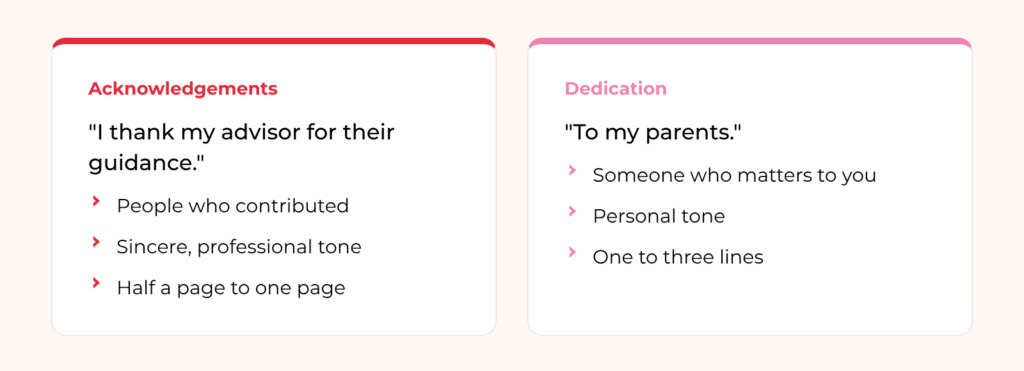
A dedication is optional. If you include one, put it on its own page, before the acknowledgements.
Thesis dedication examples
- “To my parents, for believing in me every step of the way.”
- “To my wife and children, for their patience during the long months of writing.”
- “To my grandmother, who taught me to love learning.”
- “To everyone who believed in this project before I did.”
Where to place the acknowledgements in a Thesis?
We recommend placing your acknowledgements at the beginning of your thesis, right after the title page (and the dedication, if you have one), and before the abstract and the table of contents.
For reference, here is an overview of the typical structure of a thesis with the acknowledgements page:
- Title Page: the title of the thesis, the author’s name, the institution’s name, the degree being pursued, the name of the thesis advisor.
- Dedication (optional)
- 👉 Acknowledgements Page
- Abstract: the objectives of the thesis, the research methodology, and the main results.
- Table of Contents: chapters and sections with their page numbers.
- Introduction: topic, objectives and structure of the thesis.
- Main Chapters: literature review, methodology, results, discussion.
- Conclusion: main findings and perspectives for future research.
- Bibliography: sources used and cited in the thesis.
- Appendices: raw data, questionnaires, additional information.
Should the acknowledgements page be numbered? Front matter pages are usually numbered in lowercase Roman numerals (i, ii, iii) or not numbered at all. Always check your university’s formatting guide.
How long should it be? Aim for half a page to one page. PhD dissertations often run longer, up to two pages.
Who to thank in your thesis, and in what order
The usual order goes from the most academic to the most personal:
- Your thesis advisor or supervisor: for their guidance, feedback and availability.
- Your committee members or examiners: for the time they spent reviewing your work.
- Your professors and program staff.
- Your internship or company supervisor, if your thesis was part of a work placement.
- Interviewees and research participants: thank them as a group if you promised them anonymity.
- Institutions and funders: labs, libraries, scholarships, grants (use the exact name required by the funder).
- Your classmates or fellow researchers.
- Your family and friends.
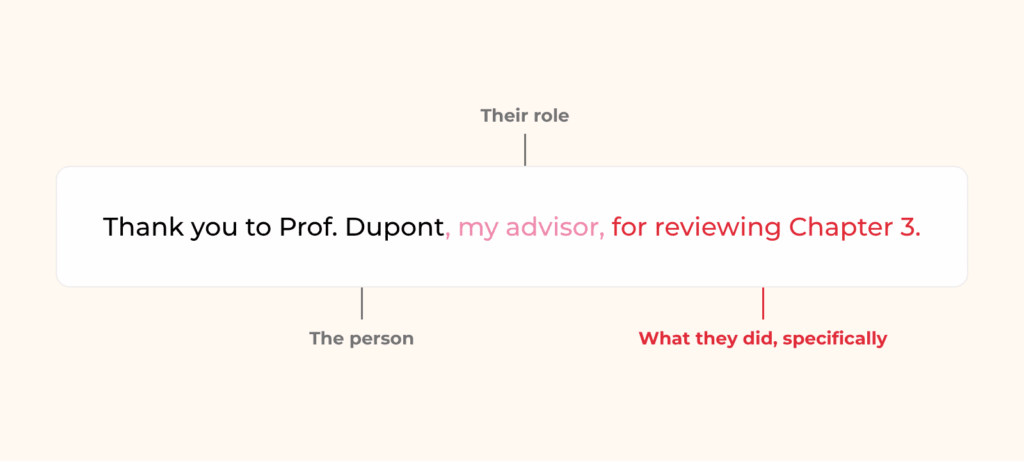
For each person, state their role and exactly how they helped. “Thank you for your detailed feedback on Chapter 3” says far more than “thank you for everything”.
How to write the acknowledgements in a Thesis or Dissertation in 6 steps
Writing acknowledgements in a thesis or dissertation may seem like a simple task, but it requires careful thought and organization to properly recognize those who contributed to your success.
1. Introduction: Start with an introductory sentence that broadly expresses your gratitude for the support received throughout your thesis project.
Example: “I wish to express my deep gratitude to all the individuals who contributed to the completion of this thesis.”
2. Academic Acknowledgements: Start by mentioning those who helped you academically. This includes your thesis advisor, professors, and members of your committee. Be specific about the nature of their contribution.
Example: “I would especially like to thank my thesis advisor, Professor Fabien Dupont, for his guidance, insightful advice, and patience throughout this project.”
3. Specific Contributions: Continue by thanking the people or institutions that provided specific resources or technical support: laboratories, libraries, experts in the field, or organizations that gave you access to data or equipment.
Example: “I am also grateful to the Laboratory of Biology and Applied Pharmacology for access to equipment and essential resources that made my research possible.”
4. Personal Support: Don’t forget to thank friends, family, and loved ones who provided moral or material support.
Example: “I wish to express my gratitude to my family for their unwavering support and to my friends for their understanding and patience during the intense moments of thesis writing.”
5. Financial Acknowledgements (if applicable): If you received a scholarship or funding, mention the organizations or individuals who made it possible.
Example: “I also thank the Mediterranean Institute of Oceanography for funding my research, without which this thesis would not have been possible.”
6. Conclusion: End your acknowledgements with a concluding sentence that reiterates your general gratitude.
Example: “To all those who contributed in any way to this thesis, I extend my sincere thanks.”
Tip: write your acknowledgements last, once the thesis is finished. You will have a complete picture of everyone who helped you.
Submit a thesis you are proud of
With Compilatio Studium, check that all your sources are properly cited and spot passages that may have been AI-generated before you submit. Hand in your thesis with peace of mind.
Useful phrases for your acknowledgements
To open:
- “I would like to thank everyone who contributed to the completion of this thesis.”
- “This thesis would not have been possible without the support of many people, to whom I am deeply grateful.”
To thank your advisor:
- “I am deeply grateful to my advisor, [Name], for the quality of their guidance and the relevance of their feedback.”
- “I owe special thanks to [Name], who supervised this thesis with rigor and kindness.”
To thank your family:
- “I thank my parents for their constant support and trust throughout my studies.”
- “Thank you to my family, who encouraged me through every moment of doubt.”
To close:
- “To everyone who contributed to this work in any way: thank you.”
- “This thesis is as much the result of collective support as of personal work. Thank you all.”
Thesis and dissertation acknowledgement examples
Acknowledgements example for a Bachelor’s Thesis
I would like to express my deep gratitude to everyone who contributed to the completion of this thesis. First, I sincerely thank my thesis advisor, Professor [Name], for their exceptional guidance, valuable advice, and constant support throughout this project.
I am also grateful to all the professors in the [Department Name] department at [University Name] for their teaching and availability.
I also wish to thank my fellow students for their moral support and enriching discussions. A big thank you to my friends and family for their understanding, patience, and constant encouragement.
Finally, I would like to express my gratitude to everyone who, directly or indirectly, contributed to the completion of this work. Your help and support have been invaluable.
Acknowledgements example for a Master’s Thesis
I would like to express my sincere thanks to all the people who supported and guided me in the completion of this Master’s thesis. First, I warmly thank my thesis advisor, Professor [Name], for their guidance, insightful advice, and constant availability.
I am also grateful to the committee members for their relevant feedback and the time they spent evaluating this work. Thank you to the professors of the [Master’s Name] program for their enriching teaching and support.
I also thank [Name of Institution or Company] for the resources provided and the logistical support that greatly facilitated the completion of this thesis.
My thanks also go to my fellow students for their camaraderie and the fruitful exchanges we had. A huge thank you to my family and friends for their moral support and unwavering encouragement.
Example of acknowledgements in a Master’s Thesis in Industrial Engineering
I would like to express my gratitude to everyone who contributed to the completion of this Master’s thesis in Industrial Engineering, conducted as a work-study program at the University of Strasbourg.
I would first like to thank my thesis supervisor, Mr. Morel, for his rigorous guidance, relevant technical advice, and availability. His expertise was crucial in directing my research and developing practical solutions.
I would also like to thank my company supervisors, Ms. Boulaya and Mr. Manaudou, for their continuous support and practical advice. Their experience and guidance were instrumental in applying theoretical concepts in a real industrial context.
Finally, I would like to thank my family and friends for their constant support and encouragement. Their assistance enabled me to overcome the challenges of this year in the work-study program.
Example of acknowledgements in a Nursing Thesis
I would like to express my deep gratitude to everyone who made the completion of this nursing thesis at IFSI Lille possible.
First, I warmly thank my thesis supervisor, Mr. Levallois, for his exceptional guidance, valuable advice, and availability throughout this project.
I also thank the trainers and staff of IFSI Lille for the quality of their teaching and their constant support, as well as the nursing teams I met during my placements, who kindly answered my questions.
A big thank you to my family and friends for their understanding, patience, and constant encouragement during this intense period of training.
PhD dissertation acknowledgements example
PhD acknowledgements follow the same logic but are usually longer: they cover several years of research and a wider network (lab, graduate school, external examiners, funders).
First and foremost, I would like to thank my advisor, Professor [Name], for their trust, scientific rigor and availability throughout my doctoral years.
I am sincerely grateful to the members of my dissertation committee, [Name] and [Name], for their careful reading and their insightful questions, and to my external examiner, [Name], for agreeing to evaluate this work.
I thank the [Name] Graduate School and the [Name] Laboratory for the stimulating environment I benefited from, and [funding body] for funding this research under grant [number].
Thank you to my fellow PhD students for the discussions, the proofreading and the much-needed coffee breaks. Finally, I thank my family and friends, without whom this long journey would not have been the same.
Research paper acknowledgement example
For a research paper or a final-year research project, keep it to one short paragraph.
I would like to thank my research teacher, [Name], for guiding me through each stage of this study, and the [school or department] for providing the resources I needed. I am also grateful to the respondents who took the time to answer my survey, and to my family for their support and encouragement.
Short acknowledgement example
I thank my advisor, [Name], for their guidance and feedback, and the faculty of [program] for their teaching. Thank you to the participants who took part in my study, and to my family for their constant support.
Personal acknowledgement example for family
I could not finish without thanking my family. Thank you to my parents, [Names], for their trust and support, both moral and material, throughout my studies. Thank you to [brother/sister] for the encouragement and the late-night proofreading. You were my greatest motivation.
Submit a thesis you are proud of
With Compilatio Studium, check that all your sources are properly cited and spot passages that may have been AI-generated before you submit. Hand in your thesis with peace of mind.
Thanking your committee at your thesis defense
At the end of your thesis defense, a few words of thanks are enough. Keep it short (two or three sentences) and start with the committee.
- “Thank you, members of the committee, for your attention and for the time you spent reviewing my work.”
- “I also thank my advisor, [Name], for their support throughout this project.”
- “I am now happy to answer your questions.”
Mistakes to avoid in your acknowledgements
- Forgetting a key person, especially your advisor or committee. Make a list before you start writing.
- Being too casual or too emotional. Acknowledgements remain part of an academic document.
- Staying vague: say what each person did for you.
- Misspelling a name or a title (Professor, Dr.). Check every name.
- Naming anonymous participants: thank them as a group if you promised confidentiality.
- Copying an example word for word: use the examples as a starting point, then make them yours.
FAQ
Are acknowledgements mandatory in a thesis?
No, they are optional in most universities, but strongly recommended. Check your program’s guidelines.
Where do acknowledgements go in a thesis or dissertation?
After the title page (and the dedication, if any), before the abstract and the table of contents.
How long should thesis acknowledgements be?
Half a page to one page for a bachelor’s or master’s thesis. PhD acknowledgements can run to two pages.
Do acknowledgements count toward the word count?
Usually not: front matter (title page, acknowledgements, abstract) is generally excluded. Check your university’s rules.
Should I write acknowledgements in the first person?
Yes. Acknowledgements are the most personal part of the thesis, even if the rest is written in a more impersonal style.
"Acknowledgements" or "acknowledgments": which spelling is correct?
Both are correct. “Acknowledgments” is more common in American English, “acknowledgements” in British English. Use the spelling of your university’s style guide and stay consistent.
To summarize
A good acknowledgements page is short, specific and well ordered: from your advisor to your family, each person gets a place and a clear mention of their role. Write it last, adapt the examples to your own story, and double-check every name and title.
Before you submit, run your thesis through a plagiarism checker with an AI detector: you make sure your sources are properly cited and that your work reflects your own thinking.
To go further
Was this article helpful?

Mohamed BADI
Committed to academic integrity and authenticity, I help students and teachers understand and prevent the risks associated with plagiarism and generative AI.